Fig.1 Geometry of the stirred tank
Computational simulation of gas dispersion in a double turbine in stirred tank
Introduction
|
|
Three - dimensional of gas dispersion in a double turbine in stirred tank is numerically studied. We used to simulation commercial CFD package Fluent 6.0.20. However, most simulations reported in the literatures only model single - phase flow, whereas multiphase mixtures are in fact common, and such cases simulation methods still require further development. This report shows short progress in develop CFD simulation of liquid - gas mixing in a stirred tank. |
|
Numerical Method
|
Numerical solutions have been obtained for steady - state three - dimensional flow a viscous incompressible fluid (water). This code solved Navier - Stokes equations with turbulent k-e model. |
Numerical geometry
|
The numerical set-up consisted of a 0.292 m diameter flat bottomed, fully baffled Perspex vessel. Agitation was provided by two 0.096 m diameter standard Rushton's turbines of 0.146 m and 0.438 m, respectively above the tank base. At the below we can see geometry of stirred tank. |
|
|
|
Fig.1 Geometry of the stirred tank |
|
|
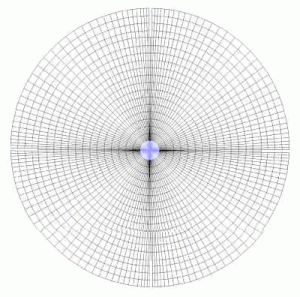
The MixSim was used to generate the numerical grid of tank. Front of view shows whole image of tank with double Rushton's turbines. Bottom view shows of inlet (purple colour) through provided gas into the tank. |
|
|
|
|
|
Fig.2 Grid of simulated tank |
Fig.3 Bottom view on the inlet of gas |
Numerical results
|
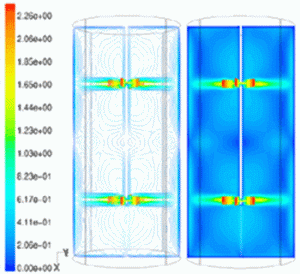
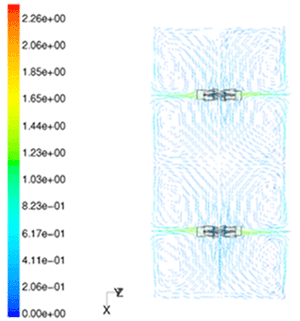
At the beginning I simulated pure mixture problem without gas. The tap water used as a liquid medium. It has been a test correctness of numerical convergence. |
|
|
|
|
Fig.4 Conturs of velocity magnitude |
Fig.5 Vectors of velocity magnitude |
|
|
For purpose to check on an accuracy of the numerical simulations I found some parameters which specify mixture problem and compared with experimental data. |
|
Mass flow rate
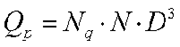
where: Nq - is a pumping number which is equal to 0.75 + - 0.15
N - is the turbine speed , rad/s
D - is the turbine diameter
|
simulation Q = 5.2e-3 m3/s literatures data Q = 4.11e-3 m3/s |
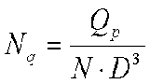
Number of mass flow rate
|
simulation Nq = 0.78 literatures data Nq= 0.62 |
|
|
For purpose to better understanding mixture phenomena in stirred tank I reported path lines arose through the rotating impellers. |
|
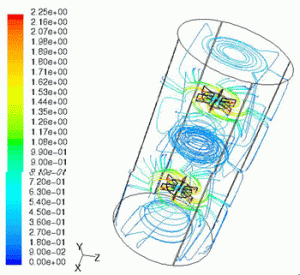
Fig. 6 The path lines of particles which are puched out from under the blades of impellers.
Dispersion model
|
|
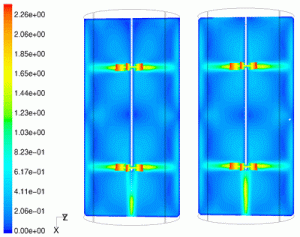
At the dispersion model the first phase used to water as the liquid medium. From the bottom of tank throughout a short hole (inlet) provided second phase, air. Total mass flow assumed and equal Qp = 4.8 10^-5 [kg/s]. At the below we can see the contour of velocity and volume fraction of air. |
|
|
|
|
|
Fig.7 The conturs of velocity, dispersion. |
Fig.8 The conturs of volume fraction of air. |