Particle Image Velocimetry and Thermometry
Particle Image Velocimetry (PIV) is a superior measurement technique for studying fluid flow. It offers many advantages over other conventional velocimetries, such as laser Doppler anemometry and hot - wire anemometry. The primary advantage is the ability to capture spatial velocity distributions simultaneously and no invasively. The fluid flow visualized by seeding it with small particle tracers. Then the flow visualisation images are analysed to obtain the velocity distribution of the flow. Many algorithms for analyzing the images have been proposed; for example (Nishino et al., 1989, Kobayashi et al., 1989) and the cross correlation technique (Adrian 1991, Hassan et al., 1992, Uemura et al., 1990, Kaga et al., 1992). In the particle tracking technique, each particle is identified in some serial images. This identification is done using the flow characteristic that the particle velocity does not change drastically in a small period, i.e. in the succeeding images. A certain particle point in the t = t+ D image is searched. This is done in a few serial images, and most probable particle streak is defined. The particle tracking technique method needs much calculation time, though three dimensional velocity distribution can be obtained.
At the below showed object used to in experiment slope flow and typical measurement techniques used to in that research work.
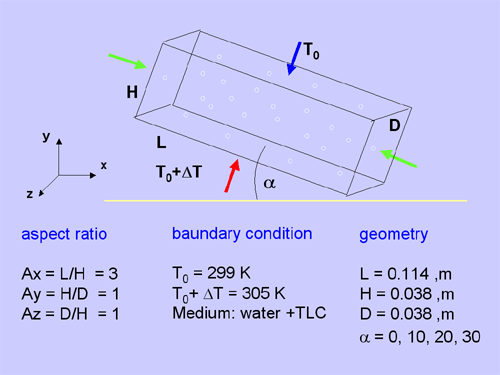
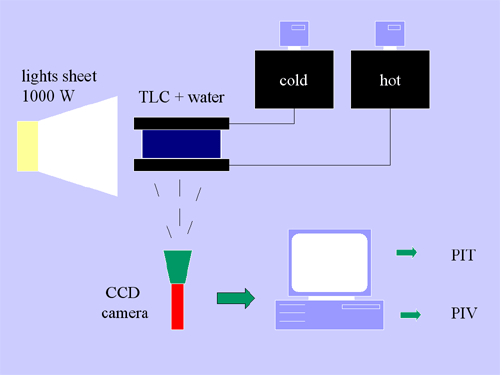
Fig. 1 Experimental cavity.
Fig. 2 Experimental set-up.