

ASU VTMX FIELD EXPERIMENT IN UTAH
VTMX (Vertical Transport and MiXing) is a program of the Dept of
Energy's Environmental Meteorology Program (EMP).
It is aimed to investigate vertical transport and mixing
in the atmospheric boundary layer (ABL). Research attention is focused
on stably stratified conditions, weak or intermittent
turbulence, and morning/evening transitions.
VTMX is centered primarily around urban basins or valleys and
will investigate phenomena
such as formation and evolution of inversions and motion of pollutants
around layers trapped in valleys.
The first field campaign for VTMX is centered on
the Salt Lake Valley over the month of October, 2000.

VTMX HOME
The overall research program is expected to contribute significantly to the
knowledge of complex-terrain flow processes and will lead to better
prediction and management tools for urban air quality.
More details about the VTMX experimental plan
can be found at the VTMX home site:
http://www.pnl.gov/VTMX/ExPlan.html
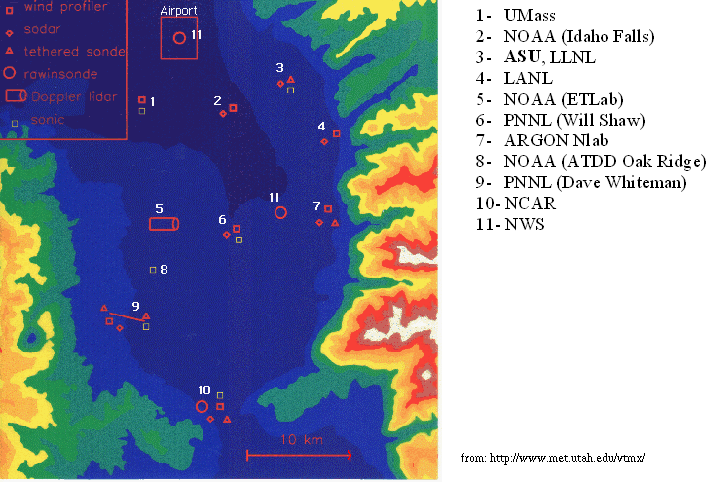
ASU is one of several groups participating in this campaign.
 (click to get location of the VTMX groups)
ASU research program gives particular attention to thermally
induced circulation, for example, slope and valley wind systems,
pooling of cold air in basins and breakup of cold pools during which the
trapped air is dispersed vertically. Several approaches, laboratory
experiments, theoretical modeling, numerical simulations and field
observations will be used for the investigations, but major emphases will
be on laboratory experiments and field observations.
For more details look
here for the accepted VTMX proposal of the ASU group.
(click to get location of the VTMX groups)
ASU research program gives particular attention to thermally
induced circulation, for example, slope and valley wind systems,
pooling of cold air in basins and breakup of cold pools during which the
trapped air is dispersed vertically. Several approaches, laboratory
experiments, theoretical modeling, numerical simulations and field
observations will be used for the investigations, but major emphases will
be on laboratory experiments and field observations.
For more details look
here for the accepted VTMX proposal of the ASU group.

The field campaign took place in October 2000.
The ASU site
was ready for the first measurements on September 30. ASU experiments have been
performed at ACS until October 18, 2000. During this time
the wind velocity, temperature and radiation data were collected continuously
using the meteorological tower. For most of the time also
data on the aerosol concentration were collected
at one position (2.5 above the ground
level) using DustTrack and TEOM. During the IOPs (IOP #1, #2, #4, #5, #6, #7)
two balloons equipped with tethersondes, DustTrack and Streaker were employed.
The meteorological airplane (2m electricaly driven model) was tested to
acquire data on pressure, humidity and temperature.
The time scale used is defined as a real number described
by the variable DayofYear. The time starts
at January 1, 2000, 00UTC as day 0, and day 1 starts on the 1st midnight.
Therefore, October 1st begins as Julian day 274 and October 1st midnight is
Julian 275.
PRELIMINARY DATA COLLECTED
at ASU Cemetery Site
(ACS)
Location: Mt. Olivet Cemetery, Salt Lake City, Utah:
LATIT: 40:45'20" LONG: -111:51' Height: 1410m
ASU Cemetery site description
Photos
Maps
Data archive
Graphs
ASU atmospheric projects
Contact us
 Email questions regarding VTMX project:
Prof. Harindra J.S. Fernando
VTMX experiment in Utah: dr Tomasz A. Kowalewski
Data analysis: dr Paolo Monti
Archive: dr Andjelka Srdic
and all VTMX related problems: Marko Princevac
Email questions regarding VTMX project:
Prof. Harindra J.S. Fernando
VTMX experiment in Utah: dr Tomasz A. Kowalewski
Data analysis: dr Paolo Monti
Archive: dr Andjelka Srdic
and all VTMX related problems: Marko Princevac
IMPORTANT NOTICE!
Data contained in this site arise from VTMX field campaign conducted in
October 2000 in the Salt Lake Valley. The data is
intended to be used primarely by the VTMX program participants.
The data may also be used for research and educational purposes.
It was agreed (VTMX meeting April, 2000)
that to use the data the appropriate acknowledgment
should be given to the persons in any publications that
result. "Appropriate" may range from co-authorship to simple
inclusion in an acknowledgment section.
Any uses of the data must receive written approval
from ASU/EDF
(Prof H.J.S. Fernando).
Last modification
ASU, Nov. 30, 2000
T.A. Kowalewski
 (click to get location of the VTMX groups)
ASU research program gives particular attention to thermally
induced circulation, for example, slope and valley wind systems,
pooling of cold air in basins and breakup of cold pools during which the
trapped air is dispersed vertically. Several approaches, laboratory
experiments, theoretical modeling, numerical simulations and field
observations will be used for the investigations, but major emphases will
be on laboratory experiments and field observations.
For more details look
here for the accepted VTMX proposal of the ASU group.
(click to get location of the VTMX groups)
ASU research program gives particular attention to thermally
induced circulation, for example, slope and valley wind systems,
pooling of cold air in basins and breakup of cold pools during which the
trapped air is dispersed vertically. Several approaches, laboratory
experiments, theoretical modeling, numerical simulations and field
observations will be used for the investigations, but major emphases will
be on laboratory experiments and field observations.
For more details look
here for the accepted VTMX proposal of the ASU group.